Special Event Generators
NREN Isolation
NREN Isolation
Any number of nren isolation checker processes can run simultaneously. They handshake with each other and for a Raft cluster, and elect one process as a leader.
All processes listen for bgp session traps
Usage: nren-isolation-checker [OPTIONS]

    Options:
        --hostname TEXT                 RabbitMQ hostname ['test-dashboard-
                                                                        storage01.geant.org', 'test-dashboard-
                                                                        storage02.geant.org', 'test-dashboard-
                                                                        storage03.geant.org']
        --monitoring TEXT               monitoring requests exchange name
                                                                        [mon.requests]
        --correlator TEXT               alarm state broadcast exchange name
                                                                        [dashboard.alarms.broadcast]
        --isolation TEXT                isolation listener worker queue name
                                                                        [dashboard.isolation]
        --broadcast TEXT                isolation state broadcast exchange name
                                                                        [dashboard.isolation.broadcast]
        --username TEXT                 RabbitMQ username [dashboard]
        --password TEXT                 RabbitMQ user password [password]
        --vhost TEXT                    RabbitMQ vhost [/dashboard]
        --watchdog INTEGER              watchdog check frequency in seconds (no
                                                                        watchdog if unset)
        --timeout INTEGER               number of seconds without correlator state
                                                                        messages to indicate error [240]
        --timeout_reconnect/--no-timeout_reconnect
                                                                        reconnect to rmq if no traps received in
                                                                        'timeout' seconds [True]
        --email_host TEXT               Email server hostname [prod-mail.geant.net]
        --email_port INTEGER            Email server port [25]
        --email_from TEXT               from address for messages to the TT system
                                                                        [alarm@geant.org]
        --email_to TEXT                 Email recipient address(es) for TT messages
                                                                        [required]
        --email_username TEXT           Email authentication username [None]
        --email_password TEXT           Email authentication password [None]
        --isogroup TEXT                 Additional groups to include in the
                                                                        isolation decision
        --nren TEXT                     Additional/updated nren groups to include
                                                                        (format: INT:STRING)
        --inventory TEXT                Inventory Provider base uris
                                                                        ['https://test-inprov01.geant.org/',
                                                                        'https://test-inprov02.geant.org/']
        --cache_hostname TEXT           Cache db hostname [test-dashboard-
                                                                        storage03.geant.org]
        --cache_dbport INTEGER          Cache db hostname [3306]
        --cache_username TEXT           Cache db username [dbcache]
        --cache_password TEXT           Cache db username [cache-secret]
        --cache_dbname TEXT             Cache db name [services_cache]
        --classifier TEXT               classifier exchange name [dashboard.deduplicated]
        --inventory_token TEXT          API Token for accessing the Inventory Provider service [default is None]
        --help                          Show this message and exit.
The default list of groups that are used to identify isolation mappings is below. This list can be extended with the –isogroup option.
DEFAULT_ACCESS_GROUP_NAMES[
"eGEANT"
]
State Checking
Active Correlator Endpoint State Checker
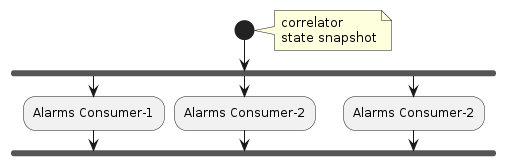
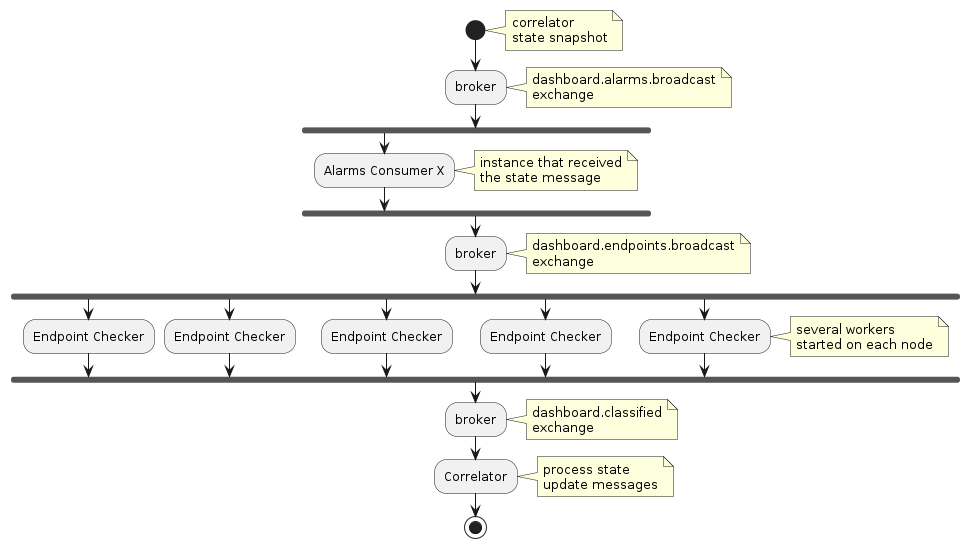
Any number of active endpoint state checker processes can run simultaneously. They all listen for correlator alarm state broadcast messages, and then distribute the active endpoints across all processes and perform the active state checks. If any worker finds a particular endpoint to be up it notifies the correlator.
Data Flow

Next Data Flow Design …

Router Isolation
Router Isolation Detector
To be implemented, but here’s the original design schematic:

Heartbeat
Heartbeat Messages
Heartbeat messages (not to be confused with heartbeats from any other part of dashboard) are sent at regular intervals into the exchange preceding classifier. Heartbeats do nothing except update the ‘last-received-ts’ counter which keeps watchdog from being triggered when there aren’t many traps coming in. These heartbeats mostly follow the same route that trap data takes, into classifier, then passed to correlator, then to the notification exchange. Finally, the Elasticsearch archiver archives heartbeats alongside other notifications. All other notifiers consume but do nothing with heartbeats. As of writing these currently are:
Argus notifier
OTRS notifier
Slack notifier
TTS notifier
Heartbeat data flow:

AMT Isolation
AMT Isolation
This package provides tools and listeners for monitoring and managing the isolation state of AMT routers.
Processes in this package listen for relevant network events, evaluate AMT router status, and broadcast isolation state messages via RabbitMQ.
This section documents the amt-isolation-checker command-line tool.
Command-Line Interface
amt-isolation-checker
Usage
amt-isolation-checker [OPTIONS]
Options
- --hostname <hostname>
RabbitMQ hostname [‘test-noc-alarms01.geant.org’, ‘test-noc-alarms02.geant.org’, ‘test-noc-alarms03.geant.org’]
- --monitoring <monitoring>
monitoring requests exchange name [mon.requests]
- --broker-exchange <broker_exchange>
alarm state broadcast exchange name [dashboard.alarms.broadcast]
- --broker-queue <broker_queue>
amt isolation queue name [dashboard.amt_isolation]
- --broadcast <broadcast>
isolation state broadcast exchange name [dashboard.deduplicated]
- --username <username>
RabbitMQ username [dashboard]
- --password <password>
RabbitMQ user password [password]
- --vhost <vhost>
RabbitMQ vhost [/dashboard]
- --watchdog <watchdog>
watchdog check frequency in seconds (no watchdog if unset)
- --timeout <timeout>
number of seconds without correlator state messages to indicate error [240]
- --timeout_reconnect, --no-timeout_reconnect
reconnect to rmq if no traps received in ‘timeout’ seconds [True]
- --inventory <inventory>
Inventory Provider base uris [’https://test-inprov01.geant.org/’, ‘https://test-inprov02.geant.org/’, ‘https://test-inprov03.geant.org/’]
- --inventory_token <inventory_token>
API Token for accessing the Inventory Provider service [default is None]
- --sentry-dsn <sentry_dsn>
Sentry DSN
- --sentry-environment <sentry_environment>
Sentry environment
Data Flow
